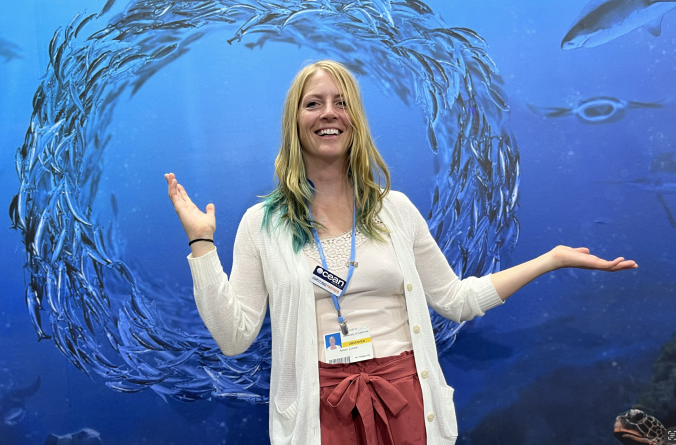
For years, I told myself, “I suck at writing,” or “I’ll never be a good scientist because I can’t write!” I even believed my writing was so scattered that people hated reading my first drafts. (That was true, but now with AI, I can better organize my thoughts before torturing others—ha!) I also realized that the more organized I made my writing, the more clear my own thoughts became and I could see the logic I was trying to construct on paper (as well as analyze the logic or lack thereof of my fellow colleagues in their writing). Ultimately, I’ve learned that getting as clear as possible is the best way to communicate effectively with any audience.
But getting to this point took work. A lot of work. I spent years trying to banish those self-sabotaging voices. I would write them down on one side of a personal journal and force myself to write a positive counter statement on the other side of the page. It felt silly at first, but eventually I gained the strength to tell those inner critic voices to “shove it.” (they are still there but less loud). I was fortunate in graduate school to have a great professor and mentor who believed in his students; he constantly reminded us that we could do amazing things because we were already smart. Finding those mentors is crucial, but I also had to do some deep soul-searching of my own.
For better or worse scientists’ “currency” is publications. The quicker you banish that negative self-talk, the quicker you can find your own voice and start writing and publishing. We often think science is purely analytical, but being a scientist is inherently creative. After completing the book The Artist’s Way, I had an epiphany: doing science taps into the exact same challenges artists face. When you are working at the edge of knowledge, you have to be creative because you are making up ways to answer questions that no one in the world has the answers to. Does that not give you chills?!
So, find that inner writer, tap into your flow, and start writing today! Here are my top writing hacks:
Read these books – all of them – and do the worksheets, you’ll thank yourself.
The Writing Workshop: Write More Write Better Write Happier by Barbara Sarnecka
Writing Science: How to write papers that get cited and proposals that get funded, by Joshua Schimel
The Artist’s Way – great for discovering your inner critic and banishing that voice (I believe the same flow state that Artists find, is what scientists can tap into as well)
Take these online courses
Coursera Writing in the Sciences
Sign up for writing retreats (many are free)
UCSD Writing Hub writing retreats (find a Writing Hub at your university)
Write the Damn Dissertation Retreat (free)
Join the Academic Writers Space Community and co-work with fellow academics
I did the 2 week trial and LOVED IT so I subscribed monthly. For me, I realized that I need the camaraderie and accountability to book writing time in my schedule and GAURD the writing time in my day, otherwise I never write.
Other writing tips and tools
I write “outlines” of my publications in Google Slides to organize the flow of my writing spatially.
My sister bought me the writing program Scrivener and I love it because I can see the pieces of my writing spatially. Scrivener is a game changer for me. If I write in a Word document I get lost in the long linear scroll of text.
What is a thesis or dissertation anyway?
Are you writing your thesis or dissertation? This UCSD Writing Hub four-part video series might be helpful to explain what is expected in a PhD thesis. Especially if your committee is demanding publications (which is a noble useful important endeavor but not the same as writing a thesis and getting your degree – which is the only university requirement of earning your degree, BTW. I have a long rant written on that topic if you want to hear? Comment below if you do ;-))
One of my dearest professors used to teach a course on How to Write Your Thesis. He has retired but he published the course in a couple of short paper, “Finding a Thesis Topic” and “Envisioning and Writing a Thesis Proposal“.
Did you find these tips, courses, books helpful? Let me know in the comments below. Are there resources you have loved? Comment below! Thanks for reading and happy writing!
Share this:
 by
by 


Recent Comments